Yes, folks, I am her daughter. And so happy about that.
November 22, 2012
Of Mothers and Motorcycles
My guess is that there are few reading this who aren't also my friends on Facebook. Yet I can't think of a single reason in this whole wide whimsical world why not to re-post this insanely awesome vintage photo of my mother being "mad, bad, and dangerous to know" (a phrase once used to describe his majesty Lord Byron and, thus of course, the highest of compliments).
November 16, 2012
Things I may never understand about the culture I live in
*Nota bene: I don't necessarily hate these things. I especially don't hate you if you happen to like any of them. I just don't understand them.
Including but not limited to:
1. Pinterest
For those of you who have already heard me rant about this, my apologies. But can we all come to terms with the fact that there is no such thing as a "Pinterest craft" or a "Pinterest recipe"? It's just a craft! It's just a recipe! From what I understand, the website doesn't generate any unique content; it only helps you find and organize existing information on this here world wide web. When I search for a recipe online using Google, I don't make the resulting recipe from FoodNetwork.com and then tell everyone, "Yeah. It's a Google recipe. I found it on Google." Why should it be any different for Pinterest?
2. Twitter
It's like Facebook statuses. Without the rest of Facebook to go with it.
3. Late-night talk shows
Too many men who think they are too funny for their own good. I just don't get it.
4. For that matter, most comedy TV
I've tried watching The Office. Not that funny. Also, Arrested Development; it just makes me uncomfortable. I don't watch Modern Family or Community or Parks and Rec or 30 Rock... can't do it. Nope. (I admit, though, my own taste in TV is not necessarily aesthetically or morally superior: I love Law & Order, Criminal Minds, I Almost Got Away With It, Storage Wars, and virtually anything on Food Network. So it's okay if you don't understand me, either.)
5. Twilight
And/or the recent preoccupation with vampires in general. (Why is everyone watching Buffy the Vampire Slayer again? Wasn't that show cancelled almost a decade ago?) But people who make a point of hating Twilight are almost as annoying as those who unabashedly love it, so I won't say anything more on the subject.
6. Keira Knightley and everything she represents
Remind me: Why do we want to be transported back to the Victorian Era? And why must Keira Knightley be the one to take us there? (And ugh, why was she cast as Anna Karenina? There are other actresses for period films, y'know.)
7. Memes
Don't get me started.
8. Ranch dressing
Okay, to be fair, that's a mystery of the ages. Moving on.
9. Calling everything "epic"
I'm pretty vocal in picking a bone about this. Things that are epic: Gilgamesh, The Odyssey, the Earth's creation, etc. Things that are not epic: the bowl of ice cream you ate for breakfast (even if you put Nutella and peanut butter on it), the trick you did on your skateboard, the Ultimate Frisbee game that went down last night, the "fail" you supposedly had by slipping and falling on the ice on your way to class, or anything else that isn't "heroic, majestic, or impressively great."
10. "Fail"
I already alluded to it in #9. This one just gets on my nerves.
11. "Legit"
This one isn't nearly as offensive as the previous two. Still, I dare you to say "legitimate" any time you are tempted to say "legit" and see what happens.
12. "I'm not gonna lie..."
Good. Shouldn't it be the default not to lie?
13. Mumford & Sons
Actually, I can level with this one a little. I'm known to love me some indie/folk from time to time. I just don't think Mumford & Sons are doing the best out of all the folkers out there. The lead singer's voice is kind of weird. And all of their songs sound the same. (Funny thing: I listened to a track called "The Boxer" from their most recent album to make sure I was willing to include them on the list. Just as I began thinking, "Wow. I actually really like this song," I realized that it's a Simon & Garfunkel cover. Case in point.)
*Nota bene: There is a lot of contemporary music that I can't stand. Mumford & Sons doesn't even begin to top the list. They at least have some talent and some soul. I mostly included them because everyone is all, "OMG THIS CHANGED MY LIFE" and, as the title of this list suggests, I just don't get it.
14. Crocs
A mystery to everyone. And yet, they continue to plague our society.
15. People who "love to read,"
but really they just read Twilight and fan fic. Or worse yet, Twilight fan fic.
16. "That awkward moment"...
when there wasn't an awkward moment and you didn't write a complete sentence to describe it.
17. "Stalkers"
Because, apparently, anyone who says hi to you or is your friend or looks at a picture that you posted on Facebook (presumably for the purpose of being looked at by others) is a stalker and is creepin' on you.
18. Why it's perfectly socially acceptable to incessantly text while you're at lunch/dinner/a party/living real life
Umm, rude.
19. Diet soda
Umm, gross. Aspartame is bad for you! And it leaves a nasty aftertaste. (YES, YOU CAN TELL)
20. "Poor college students" with Macbooks
If you're eating Ramen for dinner every night, chances are, you can't afford that Macbook. Get a normal computer and splurge on a PB&J for dinner.
21. Cats
I love 'em too. But I feel like everyone else loves them in a different way. All of a sudden. Why so many cats? Seriously. Why is that a thing?
Wow. That was therapeutic. Did I leave anything crucial out?
Including but not limited to:
1. Pinterest
For those of you who have already heard me rant about this, my apologies. But can we all come to terms with the fact that there is no such thing as a "Pinterest craft" or a "Pinterest recipe"? It's just a craft! It's just a recipe! From what I understand, the website doesn't generate any unique content; it only helps you find and organize existing information on this here world wide web. When I search for a recipe online using Google, I don't make the resulting recipe from FoodNetwork.com and then tell everyone, "Yeah. It's a Google recipe. I found it on Google." Why should it be any different for Pinterest?
2. Twitter
It's like Facebook statuses. Without the rest of Facebook to go with it.
3. Late-night talk shows
Too many men who think they are too funny for their own good. I just don't get it.
4. For that matter, most comedy TV
I've tried watching The Office. Not that funny. Also, Arrested Development; it just makes me uncomfortable. I don't watch Modern Family or Community or Parks and Rec or 30 Rock... can't do it. Nope. (I admit, though, my own taste in TV is not necessarily aesthetically or morally superior: I love Law & Order, Criminal Minds, I Almost Got Away With It, Storage Wars, and virtually anything on Food Network. So it's okay if you don't understand me, either.)
5. Twilight
And/or the recent preoccupation with vampires in general. (Why is everyone watching Buffy the Vampire Slayer again? Wasn't that show cancelled almost a decade ago?) But people who make a point of hating Twilight are almost as annoying as those who unabashedly love it, so I won't say anything more on the subject.
6. Keira Knightley and everything she represents
Remind me: Why do we want to be transported back to the Victorian Era? And why must Keira Knightley be the one to take us there? (And ugh, why was she cast as Anna Karenina? There are other actresses for period films, y'know.)
7. Memes
Don't get me started.
8. Ranch dressing
Okay, to be fair, that's a mystery of the ages. Moving on.
9. Calling everything "epic"
I'm pretty vocal in picking a bone about this. Things that are epic: Gilgamesh, The Odyssey, the Earth's creation, etc. Things that are not epic: the bowl of ice cream you ate for breakfast (even if you put Nutella and peanut butter on it), the trick you did on your skateboard, the Ultimate Frisbee game that went down last night, the "fail" you supposedly had by slipping and falling on the ice on your way to class, or anything else that isn't "heroic, majestic, or impressively great."
10. "Fail"
I already alluded to it in #9. This one just gets on my nerves.
11. "Legit"
This one isn't nearly as offensive as the previous two. Still, I dare you to say "legitimate" any time you are tempted to say "legit" and see what happens.
12. "I'm not gonna lie..."
Good. Shouldn't it be the default not to lie?
13. Mumford & Sons
Actually, I can level with this one a little. I'm known to love me some indie/folk from time to time. I just don't think Mumford & Sons are doing the best out of all the folkers out there. The lead singer's voice is kind of weird. And all of their songs sound the same. (Funny thing: I listened to a track called "The Boxer" from their most recent album to make sure I was willing to include them on the list. Just as I began thinking, "Wow. I actually really like this song," I realized that it's a Simon & Garfunkel cover. Case in point.)
*Nota bene: There is a lot of contemporary music that I can't stand. Mumford & Sons doesn't even begin to top the list. They at least have some talent and some soul. I mostly included them because everyone is all, "OMG THIS CHANGED MY LIFE" and, as the title of this list suggests, I just don't get it.
14. Crocs
A mystery to everyone. And yet, they continue to plague our society.
15. People who "love to read,"
but really they just read Twilight and fan fic. Or worse yet, Twilight fan fic.
16. "That awkward moment"...
when there wasn't an awkward moment and you didn't write a complete sentence to describe it.
17. "Stalkers"
Because, apparently, anyone who says hi to you or is your friend or looks at a picture that you posted on Facebook (presumably for the purpose of being looked at by others) is a stalker and is creepin' on you.
18. Why it's perfectly socially acceptable to incessantly text while you're at lunch/dinner/a party/living real life
Umm, rude.
19. Diet soda
Umm, gross. Aspartame is bad for you! And it leaves a nasty aftertaste. (YES, YOU CAN TELL)
20. "Poor college students" with Macbooks
If you're eating Ramen for dinner every night, chances are, you can't afford that Macbook. Get a normal computer and splurge on a PB&J for dinner.
21. Cats
I love 'em too. But I feel like everyone else loves them in a different way. All of a sudden. Why so many cats? Seriously. Why is that a thing?
Wow. That was therapeutic. Did I leave anything crucial out?
November 12, 2012
Snow had fallen, snow on snow, snow on snow
After my perfect autumn Thursday (and aren't Thursdays already kind of autumnal in their own right?) came a Friday that brought winter with it in full force. What started as a sweet, drizzly rain in the morning quickly escalated to winter wonderland-status faster than Burl Ives could have narrated it in song. I was expecting to feel rather annoyed with this drastic change in weather, as fall is my favorite season after all, and why should I have to scrape ice off my windshield in the morning nearly two full weeks before Thanksgiving? Also, I'm known to have some pretty embarrassing pratfalls when campus gets icy. Also, turns out my black suede boots aren't waterproof (I know, I know, I'm not sure this should have come as a surprise to me).
But, y'know... I have an awful lot of cute scarves that beckon me from their little bin in the corner of my closet. To say nothing of the knitted berets. And my sweaters, they are so inviting. Putting on my black wool coat that afternoon was like greeting an old friend. There was something incredibly peaceful about sitting in the office watching the cold flurry happening outside my window. Before long, I was downright enthusiastic about the wintry day, and even more so about the wintry night ahead. I left campus long after sunset, but the darkness hadn't fully settled in. The combination of clouds and fallen snow and streetlamps and reflected light made the sky an exquisite shade of mauve. It was a little eerie, admittedly. Mostly magical, though.
I came home to a cozy apartment: my blanket, my legwarmers, Seinfeld reruns on TBS. Some friends ended up joining me for my snowed-in evening. We played chess, listened to bossa nova, and ultimately wished our power would go out like the apartment complex next door so that we'd have an excuse to light all the candles and snuggle up against the elements. (Okay, that might have just been me. I had similar fantasies just before y2k.) We turned out all the lights and used a flashlight while playing parlour games. (No, seriously. We took our cues from this hilarious Wikipedia list.) Sometimes my life really is that good.
Once everyone had ambled back to their own dwellings around 2 a.m., my roommates and I stepped out onto the cold stone balcony in awe of the fact that it still wasn't dark. The sky was still dimly lit up in a tawny pinkish purplish hue. The frosty matte finish of the sky made the sparkle of the glistening snow crystals all the more stunning. We opened our blinds to let in that cotton candy light glowing ambient and quiet. I fell asleep on the couch in total peace.
I woke up to this picturesque little scene outside my living room window on Saturday morning. I felt like I was in a snowglobe, surrounded by a certain fragile beauty. I was filled with gratitude. Everything I had to do that day seemed at least a thousand times more enchanting with this as my backdrop. I could read a novel! (I could write a novel!) I could write a letter! I could write five letters! I could tidy my room! I could take a nap in the company of sugarplum fairies! I could grade papers, and even that would be magical because that tree outside looks like a giant snowflake and isn't the world just wonderful?!?!
What I did instead was probably the best thing of all. I made a hearty beef stew. While I was chopping vegetables and waiting for the meat pan to deglaze, I danced around to Ella and Louis in my leg warmers and a pirate hat leftover from my Halloween costume (Captain Hook, for the record). I twirled and I sang and I marveled in this life that is mine.
The snow really is magic.*
Ella Fitzgerald and Louis Armstrong,
"I've Got My Love to Keep Me Warm"
(aka my Saturday kitchen soundtrack)
"I've Got My Love to Keep Me Warm"
(aka my Saturday kitchen soundtrack)
*I added a handful of that magic snow to my stew and, needless to say, it's the most delicious batch I have made to date.
November 9, 2012
Staff Picks Shelf
Yesterday was a perfect fall day. My sweater was just warm enough against the slight chill, the leaves were crunchy underfoot, the air smelled faintly of earth and cinnamon, the light was dim and moody. I nobly achieved all most of what I set out to do in the afternoon: grading a batch of papers, sending out some important e-mails, moseying on over to the administration building about registration, going to the bank, pretending I'd showered, etc. Both the student at the registrar's office and the bank teller asked me about my upcoming Thanksgiving plans, and I was able to respond with all the joy in my heart that I'm going home to Michigan. I played John Mayer's Born and Raised (an album I came to love somewhere in the middle of Iowa on a summer roadtrip) as I took an evening drive to the Orem Public Library. I donated $20 to the library in exchange for their letting me keep all my checked-out materials an extra two or three weeks. (It's a wonder they haven't revoked my library card after lo these four years of nothing but overdue books.) I'm glad my Barefoot Contessa cookbook still wasn't due for another week or so; I've been meaning to try her rosemary white bean soup and caramelized butternut squash, just to name a couple. In the courtyard between the fiction wing and the audiovisual wing, I saw two young children racing down a hill on their stomachs. The stars are coming out much earlier now that we're not saving daylight anymore.

There you have it: a few seasonal favorites of mine that have been following me around of late and inspiring me. So, tell me. What's on your Staff Picks shelf? (No, seriously. I'd love recommendations. And it's kind of a fun thought experiment for a sweet drizzly morning like this.)
One of my favorite things about the library is looking at the Staff Picks shelves. A mysterious library worker named Eliot (whom I have yet to meet and/or thank in person and/or marry) has changed my life more than once with his recommendations, not the least of which was my haphazard decision to pick up The History of Love from off his shelf in early 2010. (Please go read that book if you haven't already. Just do it. For Eliot.) As I passed those beloved shelves last night, each of them beckoning me and tempting me to read something notforschool, I had a thought: What would I pick? If I had the exquisite privilege of being a librarian with such a shelf, what would go on it? Obviously, my choices would change over time to reflect mood and season and new discoveries. But what would I choose right now?
I have given this a little thought and have decided to let you in on it. Since I am known to check out (and subsequently return late) books, DVDs, and CDs from the Orem Public Library, I will give a handful of Staff Picks for each category. The unifying theme is "me right now" (which is, more or less, autumn).
1. Wuthering Heights by Emily Brontë

Moody. Dark. Romantic. Wuthering. It's everything you want in an autumn read, really. The protagonist is a volatile orphan named Heathcliff who falls in love with his childhood friend Catherine. He lives on a lonely estate in the moorlands called Thrushcross Grange. I'm not sure it gets more decidedly autumnal than that. I have really sweet memories of reading this on a cool Saturday morning in November 2010, wrapped in a comforter and daydreaming about hot cider. Yeah, it's that kind of book.
2. The Great Gatsby by F. Scott Fitzgerald
I recently read this book for the second time and was amazed at how much I enjoyed the experience. Gatsby isn't just for high schoolers! Who would have thought? Seriously. It's for everyone who loves beautiful, lyrical prose and a story that captures the spirit of a bygone era. To say nothing of the fact that the novel really is suited to autumnal weather and all it represents. Read more about it in my GoodReads review.
3. The Name of the Rose by Umberto Eco
Monks. Monasteries. Murder. Need I say more? The novel is long, but it is well worth your time. Bonus points if you have a fireplace in front of which to enjoy this historical murder mystery.
- Honorable Mentions for Books: Pale Fire, The Big Book of Soups & Stews
4. The Secret Garden (1993)
This movie was a major part of my childhood. I watched it again last week for the first time in years. I marveled. I cried. The cinematography is gorgeous, the themes are timeless and beautiful, the music is haunting. You will fall in love when you watch it. I'm not even sure with whom or what: Dicken? (I'll admit, I had a crush on him as a young'un.) The fanciful wonder of childhood? The world in all its beauty? Probably all of the above. Just trust me, you'll fall in love.
5. Annie Hall (1977)
Always a winner in my book (er, DVD player). A non-linear love story, both funny and heartbreaking in real ways. Per usual, Woody Allen really delivers on the witty dialogue, creative technique, and memorable scenes. Something about the 1970's academic sensibilities and the New York City setting make this a good choice for a Saturday afternoon in autumn.
6. Dead Poets Society (1989)
The New England boarding school milieu practically begs you to watch this in the fall. Look at all those matching crimson sweaters! Also, this happens to be one of my favorite films of all time. You really can't beat a story about a group of boys who go out into the woods because they want to live deliberately, to "live deep and suck out all the marrow of life"—in other words, read poetry. And live it. (Umm, marry me today?)
- Honorable Mentions for Movies: October Sky, Big Fish
7. Early in the Morning, James Vincent McMorrow
This whole album is gorgeous and haunting. McMorrow's voice is tender and reveals an old soul. You really can't go wrong spending an autumn morning with him. I especially love "Hear the Noise that Moves So Soft and Low," "This Old Dark Machine," "Early in the Morning, I'll Come Calling," and "Down the Burning Ropes."
8. Fleet Foxes, Fleet Foxes
If God hadn't invented autumn, Fleet Foxes would have. Their music has all the moody nostalgia you could ask for: melodies that respond to your ancient memory, that sing to you from the dust. I could likewise recommend the record Hopelessness Blues, but their self-titled album was my first love and it features unmistakably autumnal songs of longing such as "Blue Ridge Mountains," "Tiger Mountain Peasant Song," "Oliver James," and... oh yeah, all of them. Fleet Foxes are a staple in my collection, but they are especially suited to this time o' the year.
9. Live at Blues Alley, Eva Cassidy
Eva Cassidy is one of those musicians with an aura of mystique from having died too young. She was not able to develop her career as fully as many of us would have liked, but this live performance recording from just before her passing is a true treasure and something to have in your collection if you like blues or folk or jazz or beautiful voices and souls. Notable autumn tracks include: "Tall Trees in Georgia," "Fields of Gold," and "Autumn Leaves." If you're anything like me, some of the songs on this album will really stick in your ribcage.
10. Portrait in Jazz, Bill Evans Trio

Bill Evans is one of those musicians who can break your heart and restore it again in one fell swoop (I'm always big on that). His music was my inspiration as I started writing my November novel. (!!!) "When I Fall In Love" is especially me right now. I'm always falling in love. With everything. And Bill understands.
10. Portrait in Jazz, Bill Evans Trio
Bill Evans is one of those musicians who can break your heart and restore it again in one fell swoop (I'm always big on that). His music was my inspiration as I started writing my November novel. (!!!) "When I Fall In Love" is especially me right now. I'm always falling in love. With everything. And Bill understands.
- Honorable Mentions for Music: Fleetwood Mac's Rumours, anything by Bon Iver (who are we kidding?)
There you have it: a few seasonal favorites of mine that have been following me around of late and inspiring me. So, tell me. What's on your Staff Picks shelf? (No, seriously. I'd love recommendations. And it's kind of a fun thought experiment for a sweet drizzly morning like this.)
November 2, 2012
Literary Abandon
Starting things is really hard.
So is finishing them, come to find.
For the past two years, I have counted myself among the ranks of those who participate in National Novel Writing Month, which takes place every November. (Learn more about NaNoWriMo here.) Brave souls, those who take up the dizzy deed of writing a novel in one month. I'm sad to say that I have yet to surrender myself wholly to the "Thirty days and nights of literary abandon!" that characterize true dedication to the cause. Instead, it turns into about thirty minutes of literary abandon in which I write a chapter, remember that I'm not James Joyce, and then allow a sort of despair about my own mediocrity to wash over me and blot out any chance that I will be 50,000 words sadder and wiser come December. "Literary abandon" becomes just "abandon." As in, giving up. Leaving my novel behind in the dust. With tumbleweed a-blowin'.
That's not to say that the stories ever go away. They live and breathe in my conversations with close friends. They duel with my unconscious at night. They nestle into my back pocket on my walks to campus and dangle from the rear-view mirror on evening drives. They send me Christmas cards and always call on my birthday. Stories are such lively companions, and loyal to boot. They don't easily forget.
So why would I ever abandon such a lovely thing as a story? Two main reasons:
1) I'm a grad student. I'm busy and stuff sometimes I guess. 2) Writing scares me.
The first "reason" is more like a pretty lame excuse. The second at least has the advantage of tugging on your heartstrings for a few moments before you realize it is equally lame and that I just need to get over my fears of vulnerability and mediocrity and judgment and realize that, while my novel may not be even 17% as literary as anything I read for my grad school seminars, it is a valuable intellectual and emotional exercise. Maybe even vital. I can't just sit back and notwriteanovel so that no one can ever accuse me of producing a shoddy novel. I have to get to the point where I would rather be a bad novelist than notanovelistatall. (In saying this, perhaps I am doing a disservice to ten-year-old Richelle, who indeed wrote novels aplenty about an impoverished girl named Rosaline. Maybe my creative genius peaked at a young age.)
This year will be different. I can feel it in my bones. The same obstacles still threaten to deter me, however, so I'm trying to cut them off at the pass. I have been telling anyone and everyone willing to listen that I'M GOING TO WRITE A NOVEL THIS MONTH! Chances are, more than one of my friends have rolled their eyes, thinking, "Sure. Why don't you send me a moon rock while you're at it?" By and large, I have been blessed with beautiful, gracious friends and family who are eager to see me take this on. If you are one of those lovely people, thank you. You are my sweetest stories, all of you.
So to kick things off, I thought I would take a trip down memory lane and reveal the opening paragraphs of my 2010 and 2011 attempts. The first was going to be called Traces, and the idea was that everyone carries some kind of grief or burden with them that is mostly hidden but occasionally surfaces in brief moments of vulnerability; everyone wears traces of their own stories. I meant to write about a few seemingly unconnected characters and let them kind of become tangent lines to each others' lives in a big web of human grace. Last year's story... well, that is an entire post waiting to happen. For now, I will let these first lines speak for themselves.
2010
Jane
could never figure out why her parents had decided to name her Jane.
Didn’t they know that it rhymed with plain?
Not to mention stain, feign, pain,
et al. As a child, she used to wonder how many people at that same
moment were slamming a car door, drinking cherry Kool-Aid, or
wondering why the very notion of infinity didn’t scare everyone
into the oblivion. (Unfortunately, mortality and its finiteness
didn’t seem too bright a prospect either.) She reassured herself
that maybe if people all around the world were engaged in the same
activity at the same time, nobody would ever have to be truly alone.
She had no reason to feel alone at the time. Yet for some reason, she
persisted in her favorite activity: play-acting as though she were an
orphan. When her mother handed her morning bowl of oatmeal, Jane
would secretly pretend it was gruel. She didn’t know what gruel
actually was, but she knew it was eaten by the likes of great orphans
like Oliver Twist. She imagined it looked a lot like oatmeal and
tasted like grasshoppers. Something about pretending to be an orphan
made Jane feel less guilty for being lonely.
2011
The
binary opposition between fiction and fact is no longer relevant: in
any differential system, it is the assertion of the space between
the entities that matters. –Paul
de Man
“Is
this her?”
Michael’s
eyes widened in disbelief and horror as the medical examiner pulled
back the sterile white sheet to reveal a pallid, lifeless version of
his wife lying on a cold metal cart. Her skin was gray, her lips
dried and pursed in an expression unique to the dead.
“That’s
her,” he said, more to himself than to the woman with the
clipboard. “But… how… you said she was murdered?”
“I’m so sorry to put you through this, Mr. Hutcheon. The police are actively investigating the circumstances surrounding your wife’s death. We do believe it was a homicide.”
October 30, 2012
In Defense of Jackson Pollock
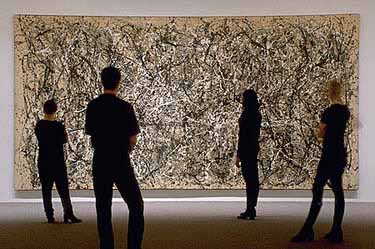
How do you start a conversation about Jackson Pollock? Well, usually, you don't. Most people have little more to say on the topic than, "A kid could do that." Now, I'm neither an art historian nor a painter myself, but this flippant comment still gets on my nerves. I always feel like I need to rush to Pollock's defense. It's not that way! Don't you see? Here we reach the point at which I run out of useful things to say. For a long time, I have intuited that there is a reason to defend abstract expressionism as legitimate art. Being able to articulate why is an entirely different story. Usually, these kinds of conversations (all forty-five seconds of them) end in a futile tug-of-war in which the other person is content to leave the deeper aesthetic questions to the snobs and I am content to be the snob. So I'm wondering: Is there any way to talk about this that doesn't end in a stalemate?
My general sense is that TA's, like children at the dinner table, are best seen and not heard. I could count the number of times I have commented in class this semester on a shop teacher's hand. Today, I couldn't help myself. The students were awkwardly squirming about, hoping that Dr. Soper would just move on and not ask them to make the seemingly impossible leap from representational Romantic art to what still looked to them like a colossal mess that only Pollock's mother could love. My comment was about one of the aesthetic tenets of the Romantic movement: dynamic organicism. The idea is that the world has an energy we can only access through our best energy: imagination. It seeks to dethrone scientific "certainties" as the privileged method of understanding the world and instead posits that maybe things really are unknowable and that our best access to the chaos inherent in the natural world is through previously disregarded senses like intuition, imagination, and creativity. Isn't there something dynamic about that massive landscape stretched before Friedrich's wanderer? My thought is that Pollock, though his paintings are physically large-scale, may be presenting the kind of chaos we see as we look closer. Didn't you have that experience while looking through a microscope in high school biology? That unsettling sense that things so small we can't even see them actually contain vibrant, squiggly universes?
As I searched to figure out what small universe might be represented by the Pollock painting, I came up with the fibers of a sweater: scratchy and haphazard if you were to look closely enough. Perhaps a better image is invoked by the painting's title: Autumn Rhythm. Doesn't it look a bit like the casual pattern leaves and twigs make on the forest floor? Or the hopelessly beautiful tangling of bare branches as you look at a grove of trees in late fall? It may not look like there is a deliberate design, but it is composed all the same. There is rhythm. There is balance. There is movement.
Movement. I couldn't help but think of the kinetic energy of a conductor during a musical performance. His movements sometimes seem abrupt and jagged, at other times soft and lyrical. The New York Times did a pretty cool story about music and gesture that you can read here. To express some of music director Alan Gilbert's thoughts on the role of a conductor, the NYU Movement Lab did a motion capture of Gilbert's directing that visually illustrates how his conducting patterns trace through the air.
We took up this battle anew today in American Humanities. I say "we" not because I was lecturing but because Dr. Soper and I were likely the only ones in the room truly convinced that ranking Pollock among the greats is not simply a frantic attempt to legitimize what students perceive as a conspiracy to include certain art in the curriculum for no other reason than to be challenging or self-congratulatory. Questions of what belongs in the so-called canon and why could take up pages and pages, but suffice it to say for now that I do believe that most artistic works and figures are taught time and time again for more than political or arbitrary reasons. Contrary to what students think, we don't read Anna Karenina just because it's long and we don't listen to Beethoven's Ninth just because it's long. There are aesthetic reasons to hail these as masterpieces—aesthetic reasons that are sometimes hard to understand without having engaged them thoughtfully, the way you do when you study... oh, say, comparative literature or music history. As someone who has only really studied art history insofar as it intersects with literary history, I am probably ill-equipped to take up this question. But I have a sympathy for all serious artistic endeavors, so it should come as no surprise that I'm becoming a Pollock apologist.
To be fair, there were a paltry two students in class today who were willing to take up the mantle alongside us. Surprise, surprise: both of them have previous training in visual art. One girl made a particularly moving comment about how she used to be skeptical re: Pollock, but she gained a new appreciation for his nuance by virtue of trying to copy his style. She couldn't, she said. Her colors often bled together in unflattering ways, and her efforts to mimic Pollock's casual abstraction always looked childish and unbalanced compared to his. Here we return to the major question at stake: What is it, then, that makes Pollock's work more than just amateur paint-flinging?
I myself confronted this question as I silently absorbed Dr. Soper's lecture and its reception among our little band of undergraduates. At one point, he asked the students to compare Pollock's Autumn Rhythm (a favorite of mine) with Romantic painter Caspar David Friedrich's Wanderer Above the Sea of Fog. As the students were chatting in their small discussion groups, all I heard were murmurs to the tune of, "Umm. How are these two alike at all?"
| Hipsters having a look-see at Jackson Pollock's Autumn Rhythm |
| Caspar David Friedrich's Wanderer Above the Sea of Fog |
In all fairness, I couldn't exactly figure out why the professor would juxtapose these particular images. It became more clear, however, as he talked about how the Friedrich painting is a representation of a man beholding immensity and perhaps contemplating his own smallness, whereas the Pollock painting implicates each viewer himself as a "wanderer." That is to say, the hipsters in the photo are actually experiencing what we imagine Friedrich's tortured Romantic subject is experiencing. Each of Pollock's paintings is like an immense landscape to be beheld; part of their impact, in my opinion, derives from their sheer size. I saw a few Pollocks in person at the Centre Pompidou in Paris a few years ago. At the time, I wasn't as converted to the cause of abstract expressionism, but I will say that standing in front of the paintings inspired a humility and awe in me I had not expected just from looking at reproductions in textbooks.
My general sense is that TA's, like children at the dinner table, are best seen and not heard. I could count the number of times I have commented in class this semester on a shop teacher's hand. Today, I couldn't help myself. The students were awkwardly squirming about, hoping that Dr. Soper would just move on and not ask them to make the seemingly impossible leap from representational Romantic art to what still looked to them like a colossal mess that only Pollock's mother could love. My comment was about one of the aesthetic tenets of the Romantic movement: dynamic organicism. The idea is that the world has an energy we can only access through our best energy: imagination. It seeks to dethrone scientific "certainties" as the privileged method of understanding the world and instead posits that maybe things really are unknowable and that our best access to the chaos inherent in the natural world is through previously disregarded senses like intuition, imagination, and creativity. Isn't there something dynamic about that massive landscape stretched before Friedrich's wanderer? My thought is that Pollock, though his paintings are physically large-scale, may be presenting the kind of chaos we see as we look closer. Didn't you have that experience while looking through a microscope in high school biology? That unsettling sense that things so small we can't even see them actually contain vibrant, squiggly universes?
As I searched to figure out what small universe might be represented by the Pollock painting, I came up with the fibers of a sweater: scratchy and haphazard if you were to look closely enough. Perhaps a better image is invoked by the painting's title: Autumn Rhythm. Doesn't it look a bit like the casual pattern leaves and twigs make on the forest floor? Or the hopelessly beautiful tangling of bare branches as you look at a grove of trees in late fall? It may not look like there is a deliberate design, but it is composed all the same. There is rhythm. There is balance. There is movement.
Movement. I couldn't help but think of the kinetic energy of a conductor during a musical performance. His movements sometimes seem abrupt and jagged, at other times soft and lyrical. The New York Times did a pretty cool story about music and gesture that you can read here. To express some of music director Alan Gilbert's thoughts on the role of a conductor, the NYU Movement Lab did a motion capture of Gilbert's directing that visually illustrates how his conducting patterns trace through the air.
What if you were to make a composite image of all these movements from a given performance? My guess is that it might look a little Pollockian. The idea here is that there is a reason a conductor does more than just tap out the meter like a human metronome. Something in all of that lyrical movement both structures the performance so that it comes to us as a measured and calculated thing of beauty and inspires a kind of emotion or energy that the musicians draw from. (Choir and orchestra members, am I getting this right?) At the core here is the idea that the order of a song—or ultimately, of the universe—does not come from a grid-like code. There is more to the story. And I think good ole' J.P. is just trying to show us in his own way.
So why are Pollock's "disasterpieces" good art? Because they invite you (perhaps even demand you) to personally experience them, they are conceptually compelling, and they represent a Romantic worldview (one that I am partial to, of course) that humbly acknowledges the seemingly chaotic vibrations that structure our reality. To say nothing of the fact that he was kind of a stud.

Intellectually, of course. His process alone is fascinating to consider: He would place his canvas on the floor so that he could walk around it, work with it, and examine it from all sides. He imagined himself as part of the painting. At the same time, he believed the painting to have a life of its own, and he tried to respect its inherent contours. Sometimes he felt as though he hadn't been true to the rhythm of a given project, so he would trash it. "It is only when I lose contact with the painting that the result is a mess," he said. "Otherwise there is pure harmony, an easy give and take, and the painting comes out well." He respected art as a kind of living thing that takes shape as the artist engages it. I admire and respect his perspective a great deal.
When it comes to naysayers, perhaps there is little more to say than this, Pollock's elegant response to a contemporary critic: "Abstract painting is abstract. It confronts you. There was a reviewer a while back who wrote that my pictures didn't have any beginning or any end. He didn't mean it as a compliment, but it was."
So why are Pollock's "disasterpieces" good art? Because they invite you (perhaps even demand you) to personally experience them, they are conceptually compelling, and they represent a Romantic worldview (one that I am partial to, of course) that humbly acknowledges the seemingly chaotic vibrations that structure our reality. To say nothing of the fact that he was kind of a stud.
Intellectually, of course. His process alone is fascinating to consider: He would place his canvas on the floor so that he could walk around it, work with it, and examine it from all sides. He imagined himself as part of the painting. At the same time, he believed the painting to have a life of its own, and he tried to respect its inherent contours. Sometimes he felt as though he hadn't been true to the rhythm of a given project, so he would trash it. "It is only when I lose contact with the painting that the result is a mess," he said. "Otherwise there is pure harmony, an easy give and take, and the painting comes out well." He respected art as a kind of living thing that takes shape as the artist engages it. I admire and respect his perspective a great deal.
When it comes to naysayers, perhaps there is little more to say than this, Pollock's elegant response to a contemporary critic: "Abstract painting is abstract. It confronts you. There was a reviewer a while back who wrote that my pictures didn't have any beginning or any end. He didn't mean it as a compliment, but it was."
October 23, 2012
Properties of Light
Sometimes I write poetry. More often than not, this happens in bursts of organic spontaneity: a thought or an image makes an indelible impression on my mind heart, and I feel keenly the artist's unique privilege and burden of capturing that moment—preserving it for myself like a fragile flower in a glass dome or a delicate seashell that comes to represent an entire summer afternoon spent on the beach in lazy, dizzy childhood glory. If someone else should happen to read that poem and see in it a glimmer of light, that is nothing short of a miracle.
One such poem came into being on a spring evening two years ago when a friend and I went to see a jazz combo perform at the Orem Public Library. My friend, he was a poet in every sense of the word: a writer, a thinker, someone who believed in books and souls and living freely. Perhaps I should thank him for the creative energy I felt that night. Or maybe it was the humble evening light, glowing quiet and dusty on the stained glass windows behind the performers. No doubt the music itself was inspiring: jazz is thrilling and beautiful for its improvisational qualities. I pulled out the little black notebook I carried with me at the time and began weighing words, feeling their contours, and writing them down as they came to me. My inspiration was a sweet little memory of evenings I used to spend in the back of my family's station wagon watching the sunset and imagining it as a glorious palette, smeared and blended by the bristles of treetops clustered along the road and behind cornfields.
"Cosmic Painters"
On long drives down US-12 in the evening,
I used to imagine
treetops as paintbrushes
coloring the canvas of the Midwestern sky:
I used to imagine
treetops as paintbrushes
coloring the canvas of the Midwestern sky:
pink for cotton
candy,
orange for Michigan campfires,
streaks of purple for moments I felt invincible.
orange for Michigan campfires,
streaks of purple for moments I felt invincible.
Now I see these same hues pierced by the jagged
mountaintops,
bleeding watercolor over the Western expanse.
Now I see
bleeding watercolor over the Western expanse.
Now I see
pink childhood,
orange lazy summers,
purple fragile moments.
orange lazy summers,
purple fragile moments.
In those colors I taste
a forbidden nectar,
painfully sweet,
robbing me of my verdant garden,
my paradise,
my place.
a forbidden nectar,
painfully sweet,
robbing me of my verdant garden,
my paradise,
my place.
I ask out loud:
Who paints the desert sky?
The poem is perhaps more interesting for its ideas than for its poetic qualities. I really did face a certain crisis of place when I first came to Utah six years ago. The mountains were glorious to me, but they forced me to reevaluate how I think about space. One thing I've noticed in my time living here is that you can just be driving along, slightly perceiving that you are on an upward incline, and within moments you'll be perched above the valley, viewing it from a totally different vantage point. That layering of heights and perspective is just not a feature of the Michigan landscape I grew up in. There, everything is framed by trees. (And oh, how I love those trees.) Here, the mountains give the world colossal, imposing edges. I distinctly remember so many times my freshman year just looking up because there was a reason to. Looming above me were mountain ranges whose distance from me I could not accurately gauge. (This is still true for me: is Y Mountain in our backyard or in a land far, far away? It's hard to know.) Sometimes those mountains made me feel small; other times, the sky seemed more tangible and the world more knowable as clouds shrouded the peaks, almost close enough to touch.
My poem specifically deals with a loss of home, using the sunset as a metaphor for how I perceive the world. My Michigan self (which is, incidentally, my younger self) had developed my own set of origin myths and explanations for why the world operated as it did. Moving to Utah (and becoming an adult, incidentally) sharply re-contextualized these questions for me, and the answers just aren't as simple when you're a twentysomething. I've since learned to rejoice in this fact. What good is being a twentysomething if you aren't daily confronted with existential crises? No doubt much of the world's art owes its creation to these kinds of crises and uncertainties. If I were to write a similar poem now, my focus would shift from the sunset to a related question of light.
One of the first differences I noticed between my home state and my current desert dwelling was the character of heat. In Michigan, as in most of the Midwest and stretching east to the Atlantic, the summer heat is imbued with a tangible, sticky humidity. The air here in Utah is much more arid, and the heat, rather than oppressively surrounding you as it seems to in a humid climate, bears a more direct relationship to the sun. Standing in the middle of a parking lot on a hot July day in Provo, you could likely bake into a potato chip on the spot. The sun is a force; you can feel it pulse and burn. Step into the shade for a moment and you might forget it's a blistering 100 degrees back in that exposed parking lot. This same phenomenon is what makes the light here seem very vertical, beaming down on us from a precise location above, like a revelation. Compare this to a place like Sweden, a place I love, a place where the light is horizontal and diffused.
I've heard that photographers and filmmakers love Scandinavia for its Nordic light. I love Scandinavia for all kinds of reasons, but that's another story. I'll admit, Utah afternoons are not my favorite. The light is so imposing and greedy, like it knows it's a gift to us. But in the evening, it is something altogether different for me. I can't count the number of times I have walked out of my office on campus or the library as the sun is setting and found myself breathless with wonder and full of gratitude. The sun (that superstar) sinks behind the mountains to the West and suddenly, its light has edges. As I look out my bedroom window upon the mountains to the east, I can see the play of light and shadows. The light has dimensions. It slants and spills over the mountain's edge. This phenomenon is especially stunning in the autumn months, when the mountainsides are covered in blushy pinks, bronzy yellows, and rusty oranges. The evening light is rosy and golden and dynamic. It glows. There are few things sweeter or holier to me than catching a glimpse of this slanted light, suspended in the air so briefly before darkness takes over.
Experiences like those not only inspire me to write, but beg me to do so. Heaven knows I only respond to this call a fraction of the time, and it's time for that to change. So here I am, sharing shards and fragments of my slanted light as it comes to me in fleeting impressions and vibrant moments that are nothing short of poetry itself.
September 27, 2010
elevator encouragement
It had to have been two years ago. Yep, I'm going to say two years. I was starting a new school year—my first school year without Dad. Let's say I was wearing corduroy (because that's always fitting for these kinds of stories) and carrying a backpack that seemed to be far heavier than its weight in books. Shuffling into the elevator, I shoved my thumb onto the button for the 3rd floor of the JFSB. I was probably staring apathetically at the doors, as we are all wont to do in elevators (especially those of us with heavy backpacks and heavier hearts). I sighed. I'm sure I did. I sighed in that world-weary kind of way. I ignored all the other people sighing and staring apathetically. People crowded in from the second floor, and I scuffed the toe of my shoe into the ground to avoid making eye contact with the newcomers. I looked back up, ready to resume the blank stare of being in transit. Maybe that's when I noticed it. A little message etched in the panel just underneath the floor numbers, next to an emergency button:
Help is on the way.
For the remainder of the semester, I often thought about this seemingly cosmic message reminding me that I wouldn't suffer alone. (For long.) It was easy to forget it once I'd exited the sliding doors and proceeded to scurry to my next class, but each and every elevator excursion reminded me anew. It was like I'd been transported to 3rd grade rather than the 3rd floor, opening my lunch box to find an encouraging Post-It note from my mother. (You can do it!, I'm thinking about you, Have a great day, I love you, et al.)
On more than one occasion, I was tempted to press that emergency button—you know, see if help really was on the way. Panting and breathless from their speedy response to my call, the emergency personnel would ask me what was wrong.
Well... I just needed some help, I guess. Do you know anything about fixing broken people? ... Oh. Okay. I didn't think so.
Still. It was comforting nonetheless to know that help was just a button away. Theoretically.
I always thought about writing a blog about that much-needed message of grace, so strangely stamped in the oddest of places. I never did because... I wouldn't know what to say. Nothing's changed, I guess, except that I've come to grips with the fact that I won't always know what to say. And that's okay. (Right?) I just needed to blurt this out before I forget about my elevator encouragement.
I started taking the stairs this semester.
Help is on the way.
For the remainder of the semester, I often thought about this seemingly cosmic message reminding me that I wouldn't suffer alone. (For long.) It was easy to forget it once I'd exited the sliding doors and proceeded to scurry to my next class, but each and every elevator excursion reminded me anew. It was like I'd been transported to 3rd grade rather than the 3rd floor, opening my lunch box to find an encouraging Post-It note from my mother. (You can do it!, I'm thinking about you, Have a great day, I love you, et al.)
On more than one occasion, I was tempted to press that emergency button—you know, see if help really was on the way. Panting and breathless from their speedy response to my call, the emergency personnel would ask me what was wrong.
Well... I just needed some help, I guess. Do you know anything about fixing broken people? ... Oh. Okay. I didn't think so.
Still. It was comforting nonetheless to know that help was just a button away. Theoretically.
I always thought about writing a blog about that much-needed message of grace, so strangely stamped in the oddest of places. I never did because... I wouldn't know what to say. Nothing's changed, I guess, except that I've come to grips with the fact that I won't always know what to say. And that's okay. (Right?) I just needed to blurt this out before I forget about my elevator encouragement.
I started taking the stairs this semester.
May 28, 2010
finding salvation
Once upon a time, something mentioned in one of my Comparative Literature classes quite possibly changed my life. This is not an entirely unusual event, but this particular instance has had a profound impact on the way I conceive of the relationship between writing and life.
"Things get created by writing them down. For all intents and purposes, things only exist as they are articulated, or written. We write to create and to secure eternity for our lives."
Thank you Professor Peer, life-changer extraordinaire. To be honest, this idea really sent my brain reeling initially because I realized, with horror, how little of my life and thoughts are actually documented somewhere. Since coming to college, my journaling skills have gone into sharp decline. (Eight-year-old Richelle would be so disappointed.) I needn't draw attention to the fact that this blog is little more than a series of weak, sporadic attempts to project myself into the virtual stratosphere. What does this all mean? That I may as well not exist? Will my life become fleeting and forgotten as a result of my carelessness?
Maybe.
Heavenly Father has his own take on this issue. In 3 Nephi 23, the Savior tells Nephi to bring Him the record he had kept of Samuel's prophecy and its fulfillment. Apparently, the record of this event was sparse, or perhaps missing altogether. At this point, Christ asks the disciples:
"How be it that ye have not written this thing?"
What of the day when He asks me to account for my own life and times? I will shyly approach Him with a stack of books and haphazard papers, maybe a thumb-drive of computer files for good measure. Flipping the pages, I will realize everything that's missing: the rock collection I used to keep in a pink plastic bin, comprised of little treasures Dad would bring home from work each day; the countless hours spent exploring and catching frogs in the woods behind my childhood home in Michigan; the little corner of the beach on Otsego Lake where I used to write my name in the sand, only to see it fade and wash away with the tide; the first time I read Whitman's "When Lilacs Last in the Dooryard Bloom'd" and realized that poetry would have a ceaseless grip on my heartstrings; my first kiss—a warm soul exchange on a crisp autumn night.
Yet. "How be it that ye have not written these things?"
I have asked myself this question, actually. And I think I discovered a piece of the answer in my French class this morning. In the 19th century, French writer Flaubert criticized the modern decline of meaningful communication. He felt that conversation has been reduced to an exchange of clichés that gives an illusion of communication or meaning without actually exploring the depths of real human thought or interaction. Quite frankly, I couldn't agree more. Look no further than the trite musings of a Hallmark card, the vapid professions of love (/lust?) made in pop song lyrics, or the hollow "dialogue" (I'm being generous here) that characterizes contemporary television programs and movies. No one even really knows what they are saying to each other anymore because they haven't thought about it for more than a nanosecond.
My problem? I think about it too much. Perhaps my fear of falling into a cliché paralyzes my own expression. Brother Fenn calls this "the paralysis of analysis." Ahem. Yes. That is my predicament. Guilty as charged. I have spent a lot of my life believing that complexity is characteristic of the divine. But is there something to be said for simplicity as well? Then again, it was an overhaul of simplicity that led to the banality of modern expression. So, how do we fix this? Well. There are no clear answers. I think, as always, the beauty lies in the balance.
As the overly analytic side of me rears its ugly head, you are probably asking: Why does this matter?
Allow me a literary example. In Eric Fottorino's novel Baisers de cinéma, the main character is on a self-journey to make sense of his life by way of understanding the past: his roots, his heritage, his origins. Part of the problem is that he doesn't know who his mother is and his father has recently passed away, leaving Gilles with a host of unaswered questions. At one point, he reflects on his father's habit of storytelling. Gilles refers to it as "telling lies." He explains that this "art suprême" is "une manière de respirer, d'exister encore un peu, de se sauver."
Telling stories is a way to breathe, to exist again (a little), to save yourself.
Maybe all I'm really doing when I write is telling stories. Lies, even. Yet somewhere in those stories—or in the process of writing them down—you and I will find salvation.
"Things get created by writing them down. For all intents and purposes, things only exist as they are articulated, or written. We write to create and to secure eternity for our lives."
Thank you Professor Peer, life-changer extraordinaire. To be honest, this idea really sent my brain reeling initially because I realized, with horror, how little of my life and thoughts are actually documented somewhere. Since coming to college, my journaling skills have gone into sharp decline. (Eight-year-old Richelle would be so disappointed.) I needn't draw attention to the fact that this blog is little more than a series of weak, sporadic attempts to project myself into the virtual stratosphere. What does this all mean? That I may as well not exist? Will my life become fleeting and forgotten as a result of my carelessness?
Maybe.
Heavenly Father has his own take on this issue. In 3 Nephi 23, the Savior tells Nephi to bring Him the record he had kept of Samuel's prophecy and its fulfillment. Apparently, the record of this event was sparse, or perhaps missing altogether. At this point, Christ asks the disciples:
"How be it that ye have not written this thing?"
What of the day when He asks me to account for my own life and times? I will shyly approach Him with a stack of books and haphazard papers, maybe a thumb-drive of computer files for good measure. Flipping the pages, I will realize everything that's missing: the rock collection I used to keep in a pink plastic bin, comprised of little treasures Dad would bring home from work each day; the countless hours spent exploring and catching frogs in the woods behind my childhood home in Michigan; the little corner of the beach on Otsego Lake where I used to write my name in the sand, only to see it fade and wash away with the tide; the first time I read Whitman's "When Lilacs Last in the Dooryard Bloom'd" and realized that poetry would have a ceaseless grip on my heartstrings; my first kiss—a warm soul exchange on a crisp autumn night.
Yet. "How be it that ye have not written these things?"
I have asked myself this question, actually. And I think I discovered a piece of the answer in my French class this morning. In the 19th century, French writer Flaubert criticized the modern decline of meaningful communication. He felt that conversation has been reduced to an exchange of clichés that gives an illusion of communication or meaning without actually exploring the depths of real human thought or interaction. Quite frankly, I couldn't agree more. Look no further than the trite musings of a Hallmark card, the vapid professions of love (/lust?) made in pop song lyrics, or the hollow "dialogue" (I'm being generous here) that characterizes contemporary television programs and movies. No one even really knows what they are saying to each other anymore because they haven't thought about it for more than a nanosecond.
My problem? I think about it too much. Perhaps my fear of falling into a cliché paralyzes my own expression. Brother Fenn calls this "the paralysis of analysis." Ahem. Yes. That is my predicament. Guilty as charged. I have spent a lot of my life believing that complexity is characteristic of the divine. But is there something to be said for simplicity as well? Then again, it was an overhaul of simplicity that led to the banality of modern expression. So, how do we fix this? Well. There are no clear answers. I think, as always, the beauty lies in the balance.
As the overly analytic side of me rears its ugly head, you are probably asking: Why does this matter?
Allow me a literary example. In Eric Fottorino's novel Baisers de cinéma, the main character is on a self-journey to make sense of his life by way of understanding the past: his roots, his heritage, his origins. Part of the problem is that he doesn't know who his mother is and his father has recently passed away, leaving Gilles with a host of unaswered questions. At one point, he reflects on his father's habit of storytelling. Gilles refers to it as "telling lies." He explains that this "art suprême" is "une manière de respirer, d'exister encore un peu, de se sauver."
Telling stories is a way to breathe, to exist again (a little), to save yourself.
Maybe all I'm really doing when I write is telling stories. Lies, even. Yet somewhere in those stories—or in the process of writing them down—you and I will find salvation.
January 10, 2010
entropy
One thing I've noticed about resolutions (particularly those of the New Years variety) is that they very rarely involve goals that are novel or surprising. "Exercise? I'd never thought of it! Writing in my journal? How innovative..." As with most things in life, the issue is not the what but the how. We're not really figuring out what to do in life per se; it's more about how we will go about accomplishing that overarching goal.
In short, it's all about being consistent.
As a perfectionist, this is a particularly difficult concept for me to grasp. Why bother doing anything if I can't devote every iota of energy I possess to the task at hand? This line of thinking is, of course, problematic because I rarely have the time or fortitude to do everything as well—nay, as perfectly—as I would like. But I'm trying to learn that that's okay.
So here, world, is my letting go of perfection. Unable to write a detailed description about my first week back in classes, I am offering you interesting tidbits and morsels. To start us off, a brief introduction to this post's title. I remember learning about this concept in 11th grade chemistry. To be totally honest, it's about the only thing I remember from 11th grade chemistry.
entropy
1. A measure of the disorder or randomness in a closed system.
2. A measure of the loss of information in a transmitted message.
3. A quantitative measure of the amount of thermal energy not available to do work.
4. The tendency for all matter and energy in the universe to evolve toward a state of inert uniformity.
5. Inevitable and steady deterioration of a system or society. *Note: I hope this particular facet of the definition is not relevant to my life.
Take that how you will. Now, onto my life's entropy.
Monday I keep thinking I'm going to find some mysterious, attractive boy in one of my classes. My first sign that I was wrong about all of this was noting that there is at least one guy in each of my classes that has a 70's style (full on Starsky and Hutch) mustache. Not acceptable.
Additionally, I learned that my syllabus for Greek & Roman Mythology would cost me $6. Yes, the syllabus. Also not acceptable.
Tuesday Yet another resolution of consistency is to watch all of the weekly devotionals this semester. Devotional Quote of the Week: "Whate'er thou art, act well thy part."
Wednesday Opened my fortune cookie to find this little nugget of wisdom: "YOU WILL MAKE MANY CHANGES BEFORE HAPPILY SETTLING." Thanks for nothing, Panda Express.
Thursday As the long and arduous process of applying to graduate school continues, I have finalized a few things. Schools currently on the docket for receiving applications from me: Indiana University, Pennsylvania State, University of Massachusetts, University of Toronto, Columbia, and BYU.
Friday I spent five hours in a room full of 180 girls for this semester's Women's Chorus retreat. At the end of the night, Sister Applonie asked us each to quickly jot something down for the Book of Wisdom. Within thirty seconds, I had composed the following haiku:
harmony is ours
infinitude is ours, dear
whisper, then shout, truth
Saturday Learned how to make homemade sushi rolls. I am quite positive that cooking needs to become a bigger part of my life.
Sunday An excerpt from my notes taken during church: "We are only limited by what we choose to become. Start learning who I am today; it's not a passive process. Part of knowing who I am is knowing what I am capable of. Assume that I'm capable of all the work the Father asks of me—otherwise, he wouldn't expect it of me! He knows what I can handle even better than I do. He knows what I can become, and He sees me in terms of my potential."
... what to make of all this is an entirely different story. These are just details in the fabric.
In short, it's all about being consistent.
As a perfectionist, this is a particularly difficult concept for me to grasp. Why bother doing anything if I can't devote every iota of energy I possess to the task at hand? This line of thinking is, of course, problematic because I rarely have the time or fortitude to do everything as well—nay, as perfectly—as I would like. But I'm trying to learn that that's okay.
So here, world, is my letting go of perfection. Unable to write a detailed description about my first week back in classes, I am offering you interesting tidbits and morsels. To start us off, a brief introduction to this post's title. I remember learning about this concept in 11th grade chemistry. To be totally honest, it's about the only thing I remember from 11th grade chemistry.
entropy
1. A measure of the disorder or randomness in a closed system.
2. A measure of the loss of information in a transmitted message.
3. A quantitative measure of the amount of thermal energy not available to do work.
4. The tendency for all matter and energy in the universe to evolve toward a state of inert uniformity.
5. Inevitable and steady deterioration of a system or society. *Note: I hope this particular facet of the definition is not relevant to my life.
Take that how you will. Now, onto my life's entropy.
Monday I keep thinking I'm going to find some mysterious, attractive boy in one of my classes. My first sign that I was wrong about all of this was noting that there is at least one guy in each of my classes that has a 70's style (full on Starsky and Hutch) mustache. Not acceptable.
Additionally, I learned that my syllabus for Greek & Roman Mythology would cost me $6. Yes, the syllabus. Also not acceptable.
Tuesday Yet another resolution of consistency is to watch all of the weekly devotionals this semester. Devotional Quote of the Week: "Whate'er thou art, act well thy part."
Wednesday Opened my fortune cookie to find this little nugget of wisdom: "YOU WILL MAKE MANY CHANGES BEFORE HAPPILY SETTLING." Thanks for nothing, Panda Express.
Thursday As the long and arduous process of applying to graduate school continues, I have finalized a few things. Schools currently on the docket for receiving applications from me: Indiana University, Pennsylvania State, University of Massachusetts, University of Toronto, Columbia, and BYU.
Friday I spent five hours in a room full of 180 girls for this semester's Women's Chorus retreat. At the end of the night, Sister Applonie asked us each to quickly jot something down for the Book of Wisdom. Within thirty seconds, I had composed the following haiku:
harmony is ours
infinitude is ours, dear
whisper, then shout, truth
Saturday Learned how to make homemade sushi rolls. I am quite positive that cooking needs to become a bigger part of my life.
Sunday An excerpt from my notes taken during church: "We are only limited by what we choose to become. Start learning who I am today; it's not a passive process. Part of knowing who I am is knowing what I am capable of. Assume that I'm capable of all the work the Father asks of me—otherwise, he wouldn't expect it of me! He knows what I can handle even better than I do. He knows what I can become, and He sees me in terms of my potential."
... what to make of all this is an entirely different story. These are just details in the fabric.
Subscribe to:
Posts (Atom)